

The human foot combines mechanical complexity and structural strength. The foot and ankle contains:
- 26 bones (one-quarter of the bones in the human body);
- 33 joints;
- more than 100 muscles, tendons (fibrous tissues that connect muscles to bones), and ligaments (fibrous tissues that connect bones to other bones); and
- a network of blood vessels, nerves, skin, and soft tissue.
These components work together to provide the body with support, balance, and mobility. A structural flaw or malfunction in any one part can result in the development of problems elsewhere in the body. Conversely, abnormalities in other parts of the body can lead to problems in the feet.
Parts of the Foot
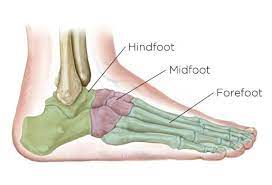
Structurally, the foot has three main parts: the forefoot, the midfoot, and the hindfoot.
Muscles
There are 20 muscles in the foot that give the foot its shape by holding the bones in position and expand and contract to impart movement.
The main muscles of the foot are:
- the tibialis anterior, which enables the foot to move upward;
- the tibialis posterior, which supports the arch;
- the fibularis muscles, which control movement on the outside of the ankle;
- the extensors, which help the ankle raise the toes to initiate the act of stepping forward; and
- the flexors, which help to stabilize the toes while they’re in contact with the ground.
There are also smaller muscles which enable the toes to lift and curl.
Tendons and Ligaments
There are elastic tissues (tendons) in the foot that connect the muscles to the bones and joints. The largest and strongest tendon of the foot is the Achilles tendon, which extends from the calf muscle to the heel. It’s strength and function on the joints facilitate running, jumping, walking up stairs, and raising the body onto the toes.
Ligaments hold the tendons in place and stabilize the joints. The longest of these, the plantar fascia, forms the arch on the sole/bottom of the foot from the heel to the toes. By stretching and contracting, it allows the arch to curve or flatten, providing balance and giving the foot strength to initiate the act of walking. Medial ligaments on the inside and lateral ligaments on outside of the foot provide stability and help enable the foot to move up and down.
Skin, blood vessels, and nerves give the foot its shape and durability, provide cell regeneration and essential muscular nourishment, and control its varied movements.


